


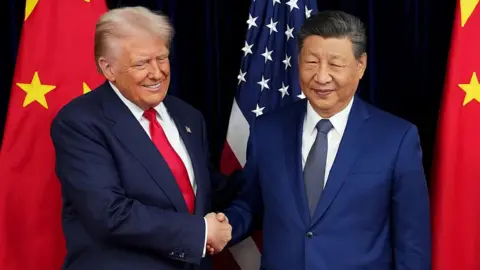
Former President Donald Trump has confirmed that he agreed to visit Beijing in spring and extended an invitation to Chinese President Xi Jinping for a state visit later next year, following a telephone conversation between the two leaders.
Trump and Xi—who held talks recently in Korea—discussed a range of issues including economic relations, the Ukraine conflict, fentanyl, and the Taiwan issue, per the president and Chinese officials.
"The U.S.-China ties is very robust!" Trump stated in a online message.
China's state news agency published a statement that indicated both countries should "keep up the momentum, proceed in the right direction on the foundation of fairness, respect and shared interests".
Earlier Talks and Economic Agreements
The officials met in Busan in the fall, following which they reached a ceasefire on import duties. The US opted to slash a 20 percent duty in half aimed at the flow of opioids.
Trade taxes continue on products from China and stand at close to half.
"Afterwards, the China-US relationship has generally maintained a steady and positive trajectory, and this is welcomed by the two countries and the international community at large," the Chinese statement noted.
- The US then retracted a potential imposition of double tariffs on Chinese goods, while the Chinese government postponed its intention to enforce its latest round of restrictions on rare earths.
Commerce Discussions
The administration's spokesperson Karoline Leavitt said that the Monday call with Xi—which took around 60 minutes—was centered on economic issues.
"The U.S. is happy with what we've witnessed from the China, and they share that sentiment," she noted.
Broader Topics
Besides discussing trade, Xi and Trump raised the issues of the conflict in Ukraine and Taiwan.
Xi stated to Trump that Taiwan's "integration into China" is critical for China's vision for the "global system after conflicts".
China has been engaged in a foreign policy clash with Japan, a American partner, over the longstanding "uncertain policy" on the sovereignty of Taiwan.
Recently, Tokyo's head Sanae Takaichi commented that a potential military action by China on Taiwan could force a Japanese military response.
Trump, though, did not refer to Taiwan in his social media update about the discussion.
US Ambassador to Japan, George Glass, previously said that the United States supports the Japanese in the aftermath of China's "coercion".

